
In the vast theater of the cosmos, galaxies are the great cities of light. Each contains billions of stars, planets, gas, and dark matter. Their brilliance, visible millions of light-years away, forms the very fabric of the observable universe.
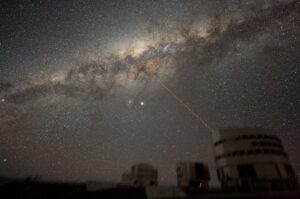
Our cosmic home, the Milky Way, is one of its jewels. More than 100,000 light-years wide, it stretches like a river of stars around an invisible core: the supermassive black hole Sagittarius A*. Around it, spiral arms wind, sheltering countless nebulae where new suns are constantly being born. Thus, each star tells a fragment of cosmic history.
If the Universe is a canvas, galaxies are its patterns. Their diversity tells the story of cosmic time: how matter came together, how light burst forth from primordial chaos.
Astronomers distinguish three major families of galaxies: spiral, elliptical, and irregular. In addition to these main forms, there are rarer variants, testimony to the infinite creativity of the cosmos.
Spiral galaxies
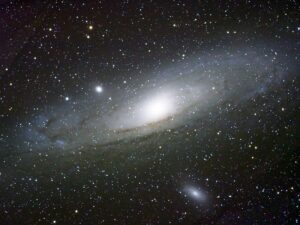
Elegant and luminous, spiral galaxies —such as the Milky Way or Andromeda —have a dense core of ancient stars surrounded by vast coiled arms. These arms contain gas, dust, and countless nebulae where new stars are constantly being born. Their orderly shape reflects a delicate balance between gravity, rotation, and interstellar matter.
Elliptical galaxies
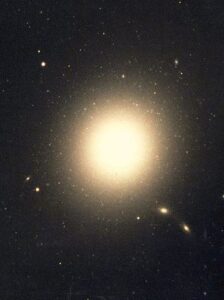
Elliptical galaxies are older, often the result of past galactic collisions. Their light is soft and golden, a sign of ancient stars and low star formation. They can contain hundreds of billions of stars, grouped together in a huge sphere with no visible structure. Their apparent silence hides a venerable age: that of the earliest epochs of the Universe.
Irregular galaxies
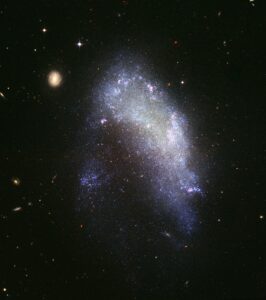
As for irregular galaxies, they appear broken, deformed by external gravitational forces. Often, these are smaller galaxies, satellites of larger neighbors, torn away and reshaped by their influence. Some, still in formation, retain the luminous chaos of the early cosmic era.
According to observations made by the James Webb Telescope, the first galaxies appeared just a few hundred million years after the Big Bang. Formed from clouds of gas that collapsed in on themselves, they lit up the first lights in the sky. Since then, mergers and interactions have shaped their forms, slowly weaving the gigantic cosmic web that we observe today.
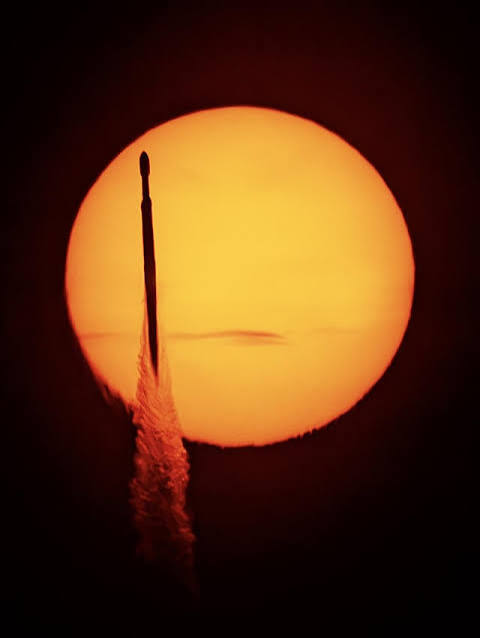
Le télescope spatial Roman de la NASA s’envole vers les étoiles
Le télescope spatial Nancy Grace Roman a décollé avec succès le 30 août 2026 à bord d’une Falcon Heavy de SpaceX depuis Cap Canaveral. Avec un champ de vision 100 fois supérieur à Hubble, il va cartographier l’énergie noire, les exoplanètes et des milliards de galaxies.
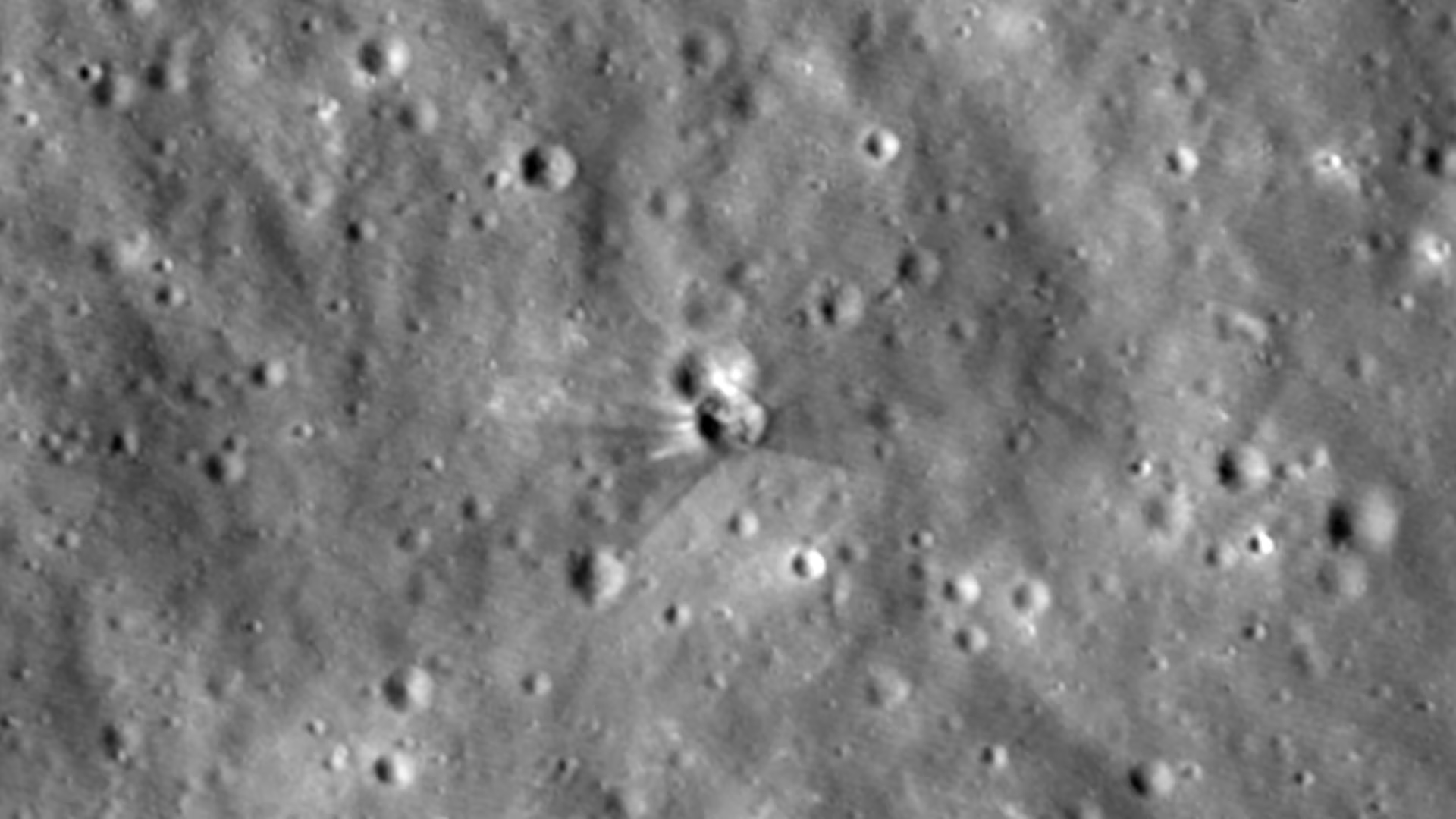
Un étage de fusée SpaceX s’écrase sur la Lune : la NASA photographie le cratère
Le 5 août 2026, un étage supérieur de Falcon 9 a percuté la Lune à 8 690 km/h. La sonde LRO de la NASA a photographié le cratère de 18,3 mètres créé lors de l’impact.
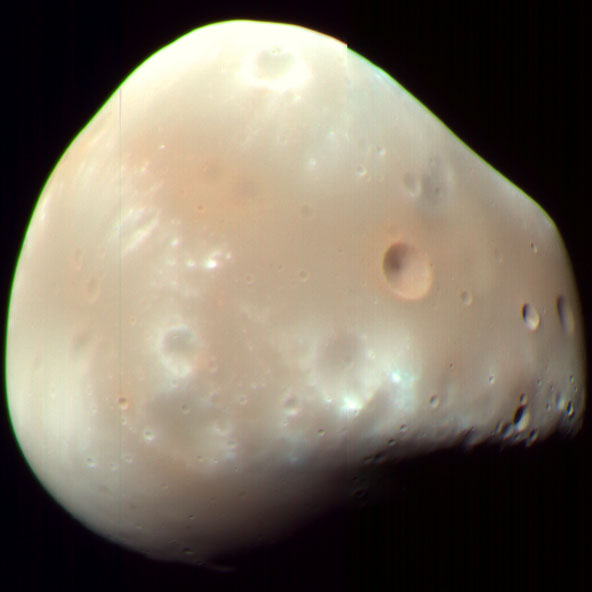
Un impact d’astéroïde unique pourrait expliquer l’apparence de Deimos
Un astéroïde de 320 mètres a frappé Deimos à 45 degrés, créant sa surface lisse et son bassin polaire sud, révèle une étude parue dans Nature Astronomy le 18 août 2026.