
Jupiter, the Colossus of the Solar System
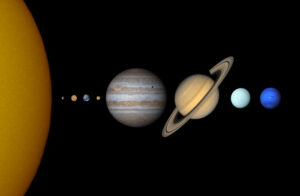
Among the stars that populate our sky, Jupiter reigns supreme. Indeed, as the fifth planet from the Sun, it embodies both power and majesty. Its diameter exceeds 142,000 kilometers —eleven times that of Earth— while its mass alone is more than twice that of all the other planets combined.
Comparison of Jupiter vs. Earth
Jupiter could contain 1,321 Earths within its volume.
Thus, through its immensity and composition, Jupiter stands out as a world of titans: a gas giant made up almost entirely of hydrogen and helium, the primordial elements that are the intact remnants of the birth of the Solar System.
An Atmosphere of Storms and Fury
Jupiter's upper atmosphere is a veritable maze of clouds of ammonia, ice, and vapor, tinged with a multitude of sulfur compounds. At first glance, these layers appear chaotic, but in reality they follow a well-ordered ballet.
In fact, winds blowing at over 300 mph in opposite directions constantly stir up the material, forming the famous bands visible from Earth: the light, colder, rising areas and the dark, warmer, descending bands.
Between these shifting boundaries, differences in pressure and temperature create gigantic whirlwinds—veritable atmospheric monsters— where cyclones and anticyclones form that can last for centuries.
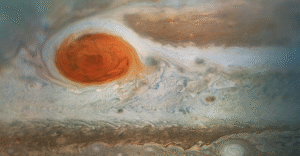
Among them, the most famous of all is undoubtedly the Great Red Spot. Discovered in the17th century, it still fascinates astronomers around the world.
Since then, this colossal vortex, larger than our entire planet, has been roaring relentlessly for at least three centuries. Images transmitted by the Juno probe reveal its dizzying structure: an ochre and crimson vortex, fueled by winds exceeding 250 mph, and sinking several hundred kilometers deep.
An Invisible Heart and a Metallic Ocean
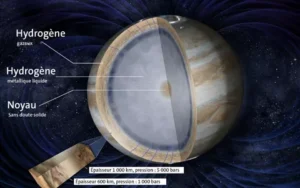
Beneath Jupiter's visible surface, pressures become simply unimaginable. As we descend gradually into the depths, matter itself transforms: hydrogen, initially gaseous in the upper layers, then becomes liquid, before turning, under the effect of colossal pressures, into metallic hydrogen.
However, this strange metal, capable of conducting electricity like an Earth metal, interacts with the planet's dizzying rotation to generate a colossal magnetic field. It is the most powerful in the entire Solar System.
Jovian auroras: a titanic light show
Around the poles, the unleashed magnetism gives rise to spectacular polar auroras. They blaze in shades of blue and violet of unprecedented intensity, fueled by particles torn from Io, the most volcanic moon in the Solar System. These auroras, a thousand times more energetic than those on Earth, bear witness to the invisible violence that reigns in Jupiter's environment.
The Kingdom of the Galilean Moons
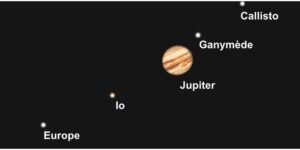
Jupiter is not alone in its celestial realm: it reigns over a veritable empire of more than 90 satellites, gravitationally bound to its immense power. Among them, four colossal moons stand out and dominate all the others: Io, Europa, Ganymede, and Callisto.
Io is a world of hell: the most volcanic ever observed. Its surface, dotted with lava lakes and sulfur geysers, shoots out incandescent plumes that can reach heights of over 300 kilometers. This incessant spectacle is fueled by the titanic tidal forces exerted by Jupiter.
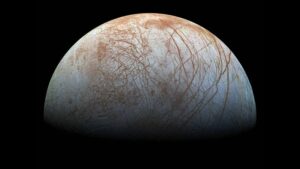
Europa offers a striking contrast: it is a sphere of pristine ice beneath which lies a vast ocean of liquid water. This submerged world could well harbor a primitive form of life.
Ganymede, the largest moon in the Solar System—even larger than Mercury— is both majestic and unique. It is the only known moon to possess its own magnetic field, an indication of an active liquid metallic core.
Callisto stands apart, calm and frozen in time. Riddled with craters, it seems to have hardly changed in four billion years. It embodies the silent memory of the Solar System.
Jupiter, Guardian of the Solar System
Jupiter has always played an essential role in cosmic balance. Its colossal gravity acts as a guardian of the Solar System, capturing or deflecting stray comets and asteroids.
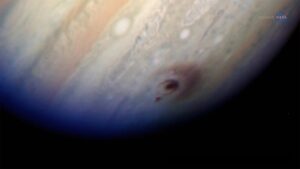
In 1994, Comet Shoemaker-Levy 9 provided a striking demonstration of this role, causing explosions visible from Earth.
The Gas Giant Laboratory
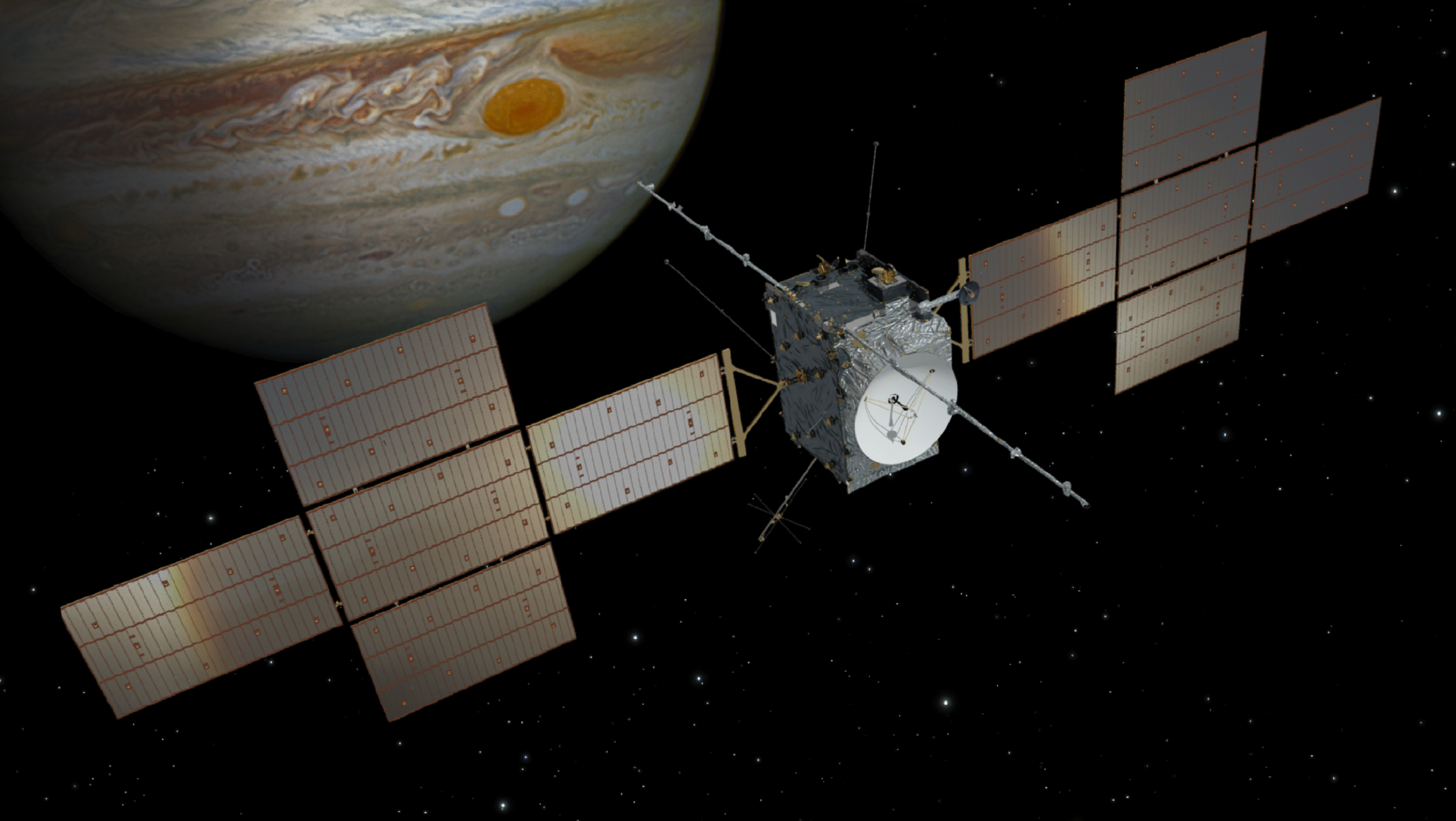
The Voyager, Galileo, and Juno probes have transformed our knowledge of this colossus. In the future, the European JUICE probe will fly over Europa, Ganymede, and Callisto to study their hidden oceans.
Did you know?
- Jupiter rotates on its axis in just 9 hours and 56 minutes, faster than any other planet.
- It gives off more heat than it receives from the Sun, proof that its core is still active.
- The Juno probe approaches to within just 5,000 km of the clouds.
- Its auroras are a hundred times more energetic than those on Earth.
- Its magnetic field could contain the entire Sun.
Le télescope spatial Roman de la NASA s’envole vers les étoiles
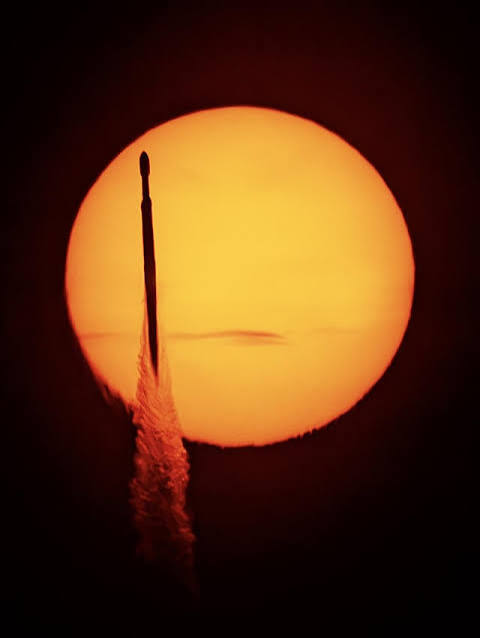
Le télescope spatial Nancy Grace Roman a décollé avec succès le 30 août 2026 à bord d’une Falcon Heavy de SpaceX depuis Cap Canaveral. Avec un champ de vision 100 fois supérieur à Hubble, il va cartographier l’énergie noire, les exoplanètes et des milliards de galaxies.
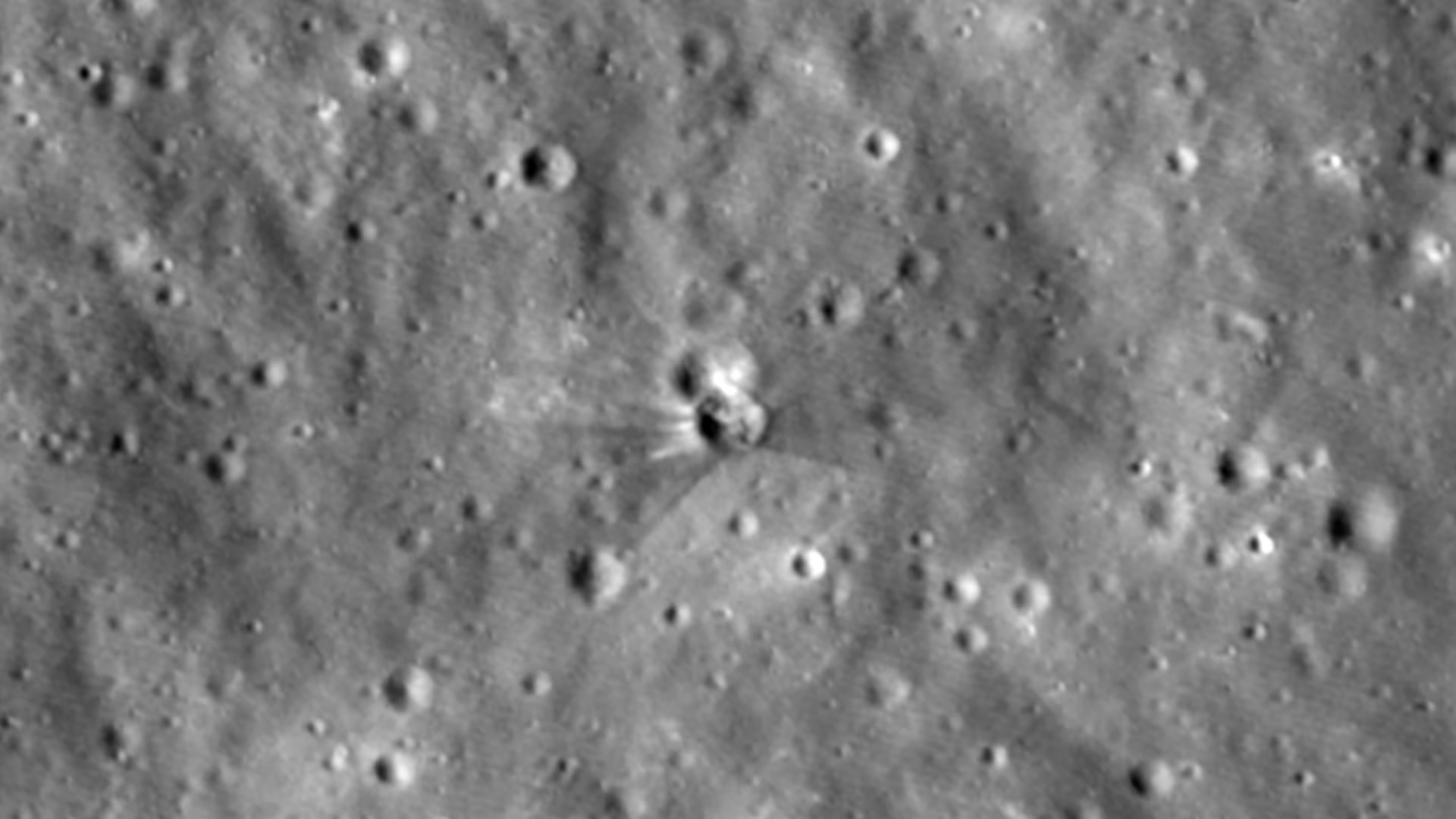
Un étage de fusée SpaceX s’écrase sur la Lune : la NASA photographie le cratère
Le 5 août 2026, un étage supérieur de Falcon 9 a percuté la Lune à 8 690 km/h. La sonde LRO de la NASA a photographié le cratère de 18,3 mètres créé lors de l’impact.
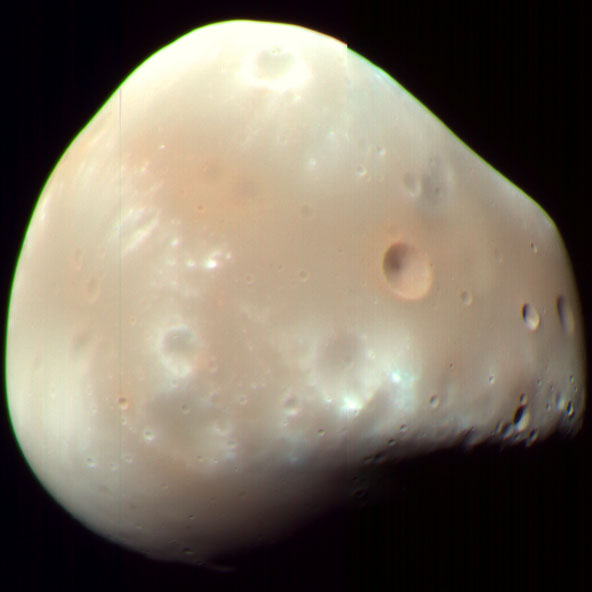
Un impact d’astéroïde unique pourrait expliquer l’apparence de Deimos
Un astéroïde de 320 mètres a frappé Deimos à 45 degrés, créant sa surface lisse et son bassin polaire sud, révèle une étude parue dans Nature Astronomy le 18 août 2026.