
Lunar Exploration in the21st Century: Between Geopolitical Rivalries, Scientific Ambitions, and the Race for Resources
After more than fifty years of absence, the Moon has once again become the center of attention. The United States, China, India, Japan, Europe, private companies: everyone wants to return there, not out of nostalgia for Apollo, but because our satellite is now at the heart of an unprecedented geopolitical, scientific, and economic race. Behind the rockets and flags, several questions arise: what is humanity really looking for on the Moon in the21st century? Why now? And above all, who will control the lunar resources and infrastructure of tomorrow?
From the Cold War to multipolar competition: fifty years of evolution
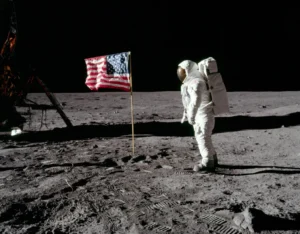
In the late 1960s, the Moon was primarily a symbolic battleground in the Cold War. The American Apollo program and the Soviet programs served to demonstrate technological, political, and military superiority. When Neil Armstrong set foot on the Moon on July 21, 1969, it was less a scientific victory than a clear message : the United States had mastered space and dominated the technological race against the USSR.
Apollo program
Definition: A series of American space missions conducted between 1961 and 1972,
culminating in six successful manned moon landings between 1969 and 1972.
Concrete example: Apollo 11 landed Neil Armstrong and Buzz Aldrin on the Moon
on July 21, 1969, watched by 600 million television viewers.
Significance: This program established American technological superiority and
symbolically ended the first phase of the space race.
Once this goal was achieved, political interest gradually waned. Manned missions ceased after Apollo 17 in December 1972, and for decades, the Moon once again became a simple scientific laboratory, studied remotely by automatic probes and terrestrial telescopes. The astronomical cost of the Apollo program — approximately $280 billion in today's dollars — was no longer justifiable once the symbolic victory had been achieved. Humanity had, apparently, "turned the page."
The emergence of new space players
However, in the background, new players began to emerge in the 2000s. China,India, Japan, andEurope launched their first lunar probes, tested orbiters, and prepared for moon landings. The Moon's proximity makes it an ideal target for mastering complex missions and demonstrating credible space capabilities. The Moon is no longer a US-USSR duel, but the arena for multipolar competition where everyone wants to prove their place in the exclusive club of space powers.
Timeline of new lunar players
This proliferation of players represents a crucial turning point. Those who now have the technical and financial capabilities to reach the Moon are no longer just the former superpowers of the Cold War, but a growing group of states that have acquired sufficient space expertise and are determined to demonstrate their geopolitical standing.
The United States versus China: the rivalry that shapes the entire new race
Inthe 21st century, the Moon has once again become a major strategic issue, largely due to the growing rivalry between the United States and China. This competition goes far beyond the space sector: it reflects a broader struggle for global influence, technological dominance, and leadership inthe 21st century.
Artemis versus Chang'e: two visions of the lunar future
On the one hand, NASA is pushing ahead with the Artemis program, announced in 2017 and accelerated in 2019 when Vice President Mike Pence declared his intention to return to the Moon by 2024, four years ahead of the initial deadline of 2028. This acceleration was not insignificant: it was explicitly aimed at staying ahead of Chinese ambitions. Artemis is not content with simply returning to the Moon; the program aims to establish a lasting presence, build a station in lunar orbit (the Lunar Gateway), and prepare for missions to Mars.
Artemis Program
Definition: U.S. program aimed at returning humans to the Moon,
establishing a permanent presence, and serving as a stepping stone to Mars.
Concrete example: Artemis III, scheduled for 2027, will land two astronauts
at the lunar south pole for a week-long mission.
Significance: This is the most ambitious lunar program since Apollo,
involving an international coalition and private partners.
On the other hand, China's Chang'e program is advancing methodically, step by step, with a clear strategy and impressive results. After several successful robotic missions, China has a clear goal: to send taikonauts to the Moon by 2030. Unlike the United States, which is increasing its international partnerships, China is developing its capabilities more autonomously, while establishing targeted cooperation, notably with Russia for a future lunar base project.
Artemis: collaborative strategy
- Return of astronauts to the lunar South Pole (2027)
- Construction of the Lunar Gateway station in orbit
- Strong cooperation: ESA, JAXA, CSA, commercial partners
- Artemis Accords: legal framework for 43 signatory nations
- 2024 budget: approximately $27 billion allocated
Chang'e: autonomous strategy
- Successful robotic missions since 2007
- Exploration of the far side (Chang'e 4, 2019)
- Sample return: 1,731 grams (Chang'e 5, 2020)
- Manned moon landing targeted before 2030
- Sino-Russian scientific base project at the South Pole

China's catch-up and American concerns
In 2019, the United States spent approximately $50 billion on its space programs, compared to $8-10 billion for China. Despite this overwhelming financial superiority, the US authorities were concerned about Beijing's rapid progress. China was gradually catching up technologically while clearly demonstrating its desire to be a major player in the international space community. The feat of Chang'e 4, which landed a rover on the far side of the Moon in 2019, demonstrated technical expertise equal to or superior to Western capabilities in certain areas.
To understand the scale of this competition, imagine two marathon runners: one has better equipment and multiple sponsors, but the other advances with methodical determination and gains ground with every mile. The United States is particularly concerned that its rival will manage to set foot on the moon before its big comeback, as this would be a major symbolic victory in the global geopolitical competition.
Beyond the Moon: Mars and Deep Space Exploration
For Washington and Beijing alike, it is no longer just a question of "going there," but of establishing a presence, testing key technologies, developing strategic partnerships, and showing the world who is leading the way in space. Both powers are viewing the competition from a broader perspective: both China and the United States are aiming to build a permanent base at the lunar south pole, a strategic location in relation to potential expeditions to Mars.
These two powers are thus engaged in a new space race that goes far beyond the Moon. Beijing plans to launch exploration missions to Neptune and Uranus Beijing plans to launch exploration missions to Neptune and Uranus in 2035 and 2040. The Moon is becoming an early battleground in a wider competition for mastery of solar system exploration and, potentially, for technological and strategic dominance inthe 21st century.
Why is the Moon so interesting to science?
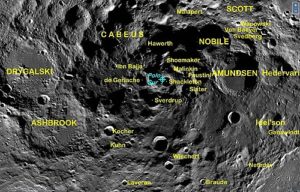
Scientifically, the Moon is a time capsule of inestimable value. It has no dense atmosphere, no weather, and no active tectonics comparable to Earth. Its rocks therefore preserve the memory of the early ages of the solar system, virtually intact for 4.5 billion years. Each lunar sample brought back tells a story about the formation of the planets, ancient cosmic impacts, and the evolution of the Earth-Moon system.
Water ice: a strategic resource and major discovery
One of the major scientific challenges concerns the water ice trapped in craters that are permanently in shadow, particularly at the South Pole. NASA is particularly targeting this region because it is one of the most promising—and scientifically fascinating—places to land. These craters, which never receive direct sunlight, maintain extremely low temperatures, allowing ice to remain there for potentially billions of years.
Permanently shadowed craters
Definition: Areas, mainly at the lunar poles, that never receive
direct sunlight due to the low inclination of the lunar axis.
Concrete example: The Shackleton crater at the South Pole, which potentially contains
ice deposits dating back billions of years.
Importance: These regions preserve water ice that could provide
drinking water, oxygen, and fuel for future lunar bases.
Recent missions have confirmed the presence of this ice. Instruments on Chandrayaan-1 and NASA's LRO probe have detected clear signatures of water ice in these regions. This discovery transforms the Moon from an abstract geopolitical target into a site with potentially essential resources for sustainable human exploration.
The peaks of eternal light: the other side of the South Pole
But not all of the South Pole is plunged into darkness. Some ridges and crater summits remain illuminated more than 80% of the time: these are the peaks of eternal light . Thanks to the very slight tilt of the lunar axis of rotation (only 1.5 degrees), these areas enjoy almost continuous sunlight, ideal for powering solar panels and offering much more stable thermal conditions than the equatorial areas, where two weeks of scorching daylight alternate with two weeks of freezing night.
This unique combination—water ice in the dark craters in close proximity to permanent solar energy on the ridges—explains why Artemis and Chang'e are targeting this region specifically. It's like having a refrigerator and a power plant side by side: optimal conditions for sustainable infrastructure.
Lunar geology and unique scientific laboratory
The Artemis program includes specific and ambitious scientific objectives. These include in-depth study of lunar geology, collection of soil samples to be brought back to Earth for analysis, and installation of scientific instruments to collect data on surface characteristics, regolith composition of the regolith (the layer of dust and fragmented rock covering the solid rock), electromagnetic interference, and charged particles in the space environment.
Chinese missions are pursuing a parallel but separate scientific program. Chang'e 4 conducted the first biological experiment outside Earth, germinating cotton seeds on the far side of the Moon. Chang'e 5 collected 1,731 grams of lunar samples in 2020, revealing in particular that the highest concentrations of water were contained in ilmenite, a titanium and iron oxide mineral present in the regolith.
Unique scientific applications of the Moon
- Radio astronomy on the dark side: Protected from terrestrial radio interference, ideal for observing the early universe
- Lunar seismology: Understanding the internal structure and tectonic history of the Moon
- Materials physics: Testing resistance to space vacuum, radiation, and extreme temperature variations
- Space biology: Studying the effects of low gravity (1/6 of Earth's) on living organisms
- Earth observation: A unique perspective for monitoring climate, the environment, and atmospheric phenomena
International scientific partnerships
In December 2017, the Japanese (JAXA) and Indian (ISRO) space agencies launched a feasibility study for a joint mission called LUPEX (Lunar Polar Exploration). This mission is based on a rover equipped with a drill and scientific instruments designed to analyze polar water ice deposits on site. According to current plans, operations on the surface are expected to last at least 3.5 months in order to meet the assigned objectives.
India is also pursuing its lunar ambitions independently. Following the success of Chandrayaan-3 in 2023, which made India the fourth nation to successfully land on the moon, the country has announced that it will take on the immense challenge of a manned lunar mission before 2050, although many crucial technical steps remain to be taken.