
Mars: The Red Planet of the Solar System
Mars, the fourth planet from the Sun, has fascinated people for centuries. Its glowing red color, visible to the naked eye in the night sky, has earned it the nickname "red planet," in reference to the Roman god of war. Yet behind this fiery appearance lies a cold, desert-like, and silent world— a remnant of a past when water may have still flowed in abundance.
A Planet Between Two Worlds
Located about 225 million kilometers from the Sun, Mars lies on the border between the terrestrial planets and the gas giants. Twice as small as Earth, it has a diameter of about 6,800 kilometers and a mass ten times less than ours.
Martian gravity: 38% of Earth's
A 75 kg astronaut would weigh only 28 kg on Mars.
Mars rotates on its axis in just over 24 hours, with a Martian day—called a sol —lasting 24 hours and 37 minutes. Its year, on the other hand, is almost twice as long: 687 Earth days to complete one full revolution around the Sun. Its axis, tilted at 25°, very close to that of Earth, also creates seasons, although they are more extreme and longer.
A Frozen and Dusty Desert
Seen up close, Mars presents an austere and grandiose face. Its red soil comes from the presence of iron oxides —rust—that cover its rocks and dunes. Dust storms can spread across the entire planet, blocking out the Sun for several weeks.
Temperatures there range from –254°F at night to 68°F at their highest during the day, under a sky that is often pink or ochre. The atmosphere, composed of more than 95% carbon dioxide, is 100 times thinner than that of Earth, insufficient to protect the surface from solar radiation or to sustain liquid water.
Mars has seen another side
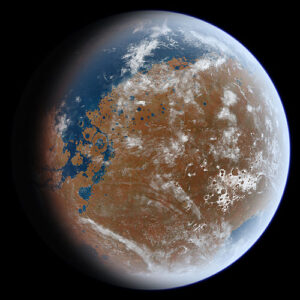
Images captured by probes reveal traces of ancient riverbeds, deltas, and dried-up lakes. Hydrated minerals indicate that more than three billion years ago, water did indeed flow on the surface. This ancient era, called the Noachian, is thought to have seen successive periods of rainfall, shallow seas, and perhaps a temperate climate.
During this period, Mars may have resembled a young Earth: with a dense atmosphere, clouds, and oceans stretching across its low plains. Scientists even suspect the existence of a vast northern ocean in the northern hemisphere, fed by rivers flowing down from the southern highlands.
Mountains and Canyons Beyond Measure
The Martian landscape is spectacular, marked by dizzying contrasts and colossal formations sculpted by time.
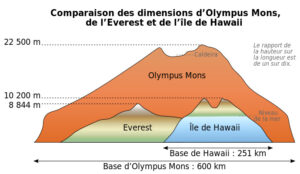
- At the center of the Tharsis plateau rises Olympus Mons, the tallest volcano in the Solar System, reaching a height of nearly 22 kilometers — almost three times that of Mount Everest.
- To the east lies Valles Marineris, a network of canyons 4, 000 kilometers long and 7 kilometers deep, which would make the Grand Canyon look like a mere crack.
A Cold Heart and a Lost Shield
Unlike Earth, Mars no longer has a global magnetic field. Its core, which is probably partially solidified, no longer produces a geodynamo capable of generating a protective magnetosphere.
This disappearance had dramatic consequences: directly exposed to solar wind, the Martian atmosphere slowly eroded, leaving the planet bare and frozen. It was this process that transformed a potentially habitable world into an arid desert swept by radiation.
Two Enigmatic Little Moons
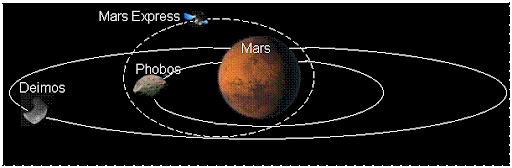
Mars is accompanied by two tiny satellites, Phobos and Deimos, probably originating from captured asteroids.
- Phobos, the larger of the two, measures just 22 kilometers in diameter and orbits so close to the planet that it rises and sets twice a day.
- Deimos, smaller and farther away, follows a calmer trajectory.
Both moons are irregular, dark, and cratered. Phobos, in particular, is slowly getting closer to Mars and will eventually crash or break up into a ring in a few tens of millions of years.
In Search of Life and the Future of Humanity
The Great Martian Mystery
For a century, Mars has been the mirror of our hopes. From Percival Lowell's first imaginary canals to modern probes, the question has never ceased to haunt humanity: has Mars ever harbored life?
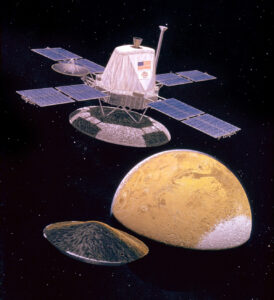
In the 1970s, the Viking probes were the first to search for biological traces in Martian soil. The Spirit, Opportunity, and then Curiosity rovers confirmed that Mars once had an environment favorable to microbial life.
Today, the Perseverance rover, in Jezero Crater, is exploring an ancient delta where fresh water flowed 3.5 billion years ago.
The Dream of a New World
But Mars is not just a laboratory of the past: it is the laboratory of the future. Robotic missions are now paving the way for humans to arrive. NASA, through the Artemis program, plans to use the Moon as a stepping stone to the Red Planet, while SpaceX is developing Starship, a fully reusable spacecraft capable of transporting entire crews to Mars.
The idea of a first manned trip around 2040 is no longer science fiction.
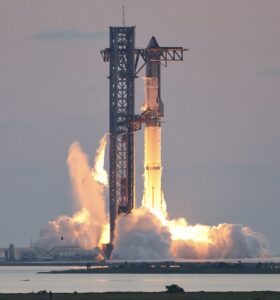
However, the challenges remain enormous: a journey time of 6 to 9 months, temperatures that can drop to –254°F, corrosive electrostatic dust, and above all, complete isolation for several years.
Despite everything, humanity persists. Mars represents both a mirror of our origins and a promise for the future. It could one day become humanity's second home — not to flee Earth, but to extend its history beyond its cradle.
Did you know?
- A Martian day (sol) lasts 24 hours and 37 minutes.
- Olympus Mons is so vast that it could cover the entire country of France.
- Martian dust storms can last for several months.
- Phobos, Mars' largest moon, is moving closer to the planet at a rate of 2 cm per year.
- Martian gravity is three times weaker than Earth's: a 75 kg astronaut would weigh about 28 kg there.
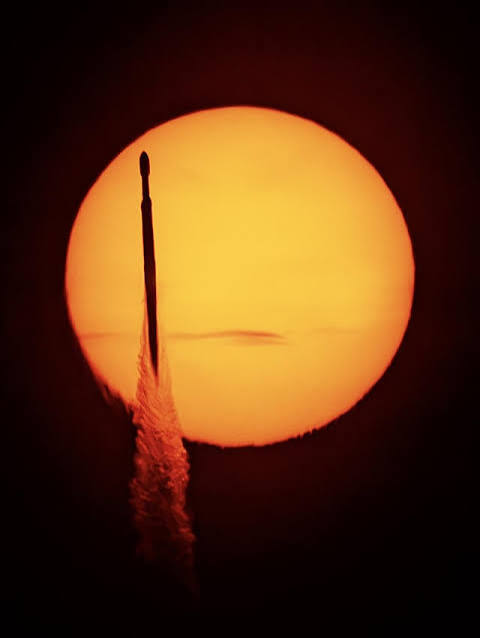
Le télescope spatial Roman de la NASA s’envole vers les étoiles
Le télescope spatial Nancy Grace Roman a décollé avec succès le 30 août 2026 à bord d’une Falcon Heavy de SpaceX depuis Cap Canaveral. Avec un champ de vision 100 fois supérieur à Hubble, il va cartographier l’énergie noire, les exoplanètes et des milliards de galaxies.
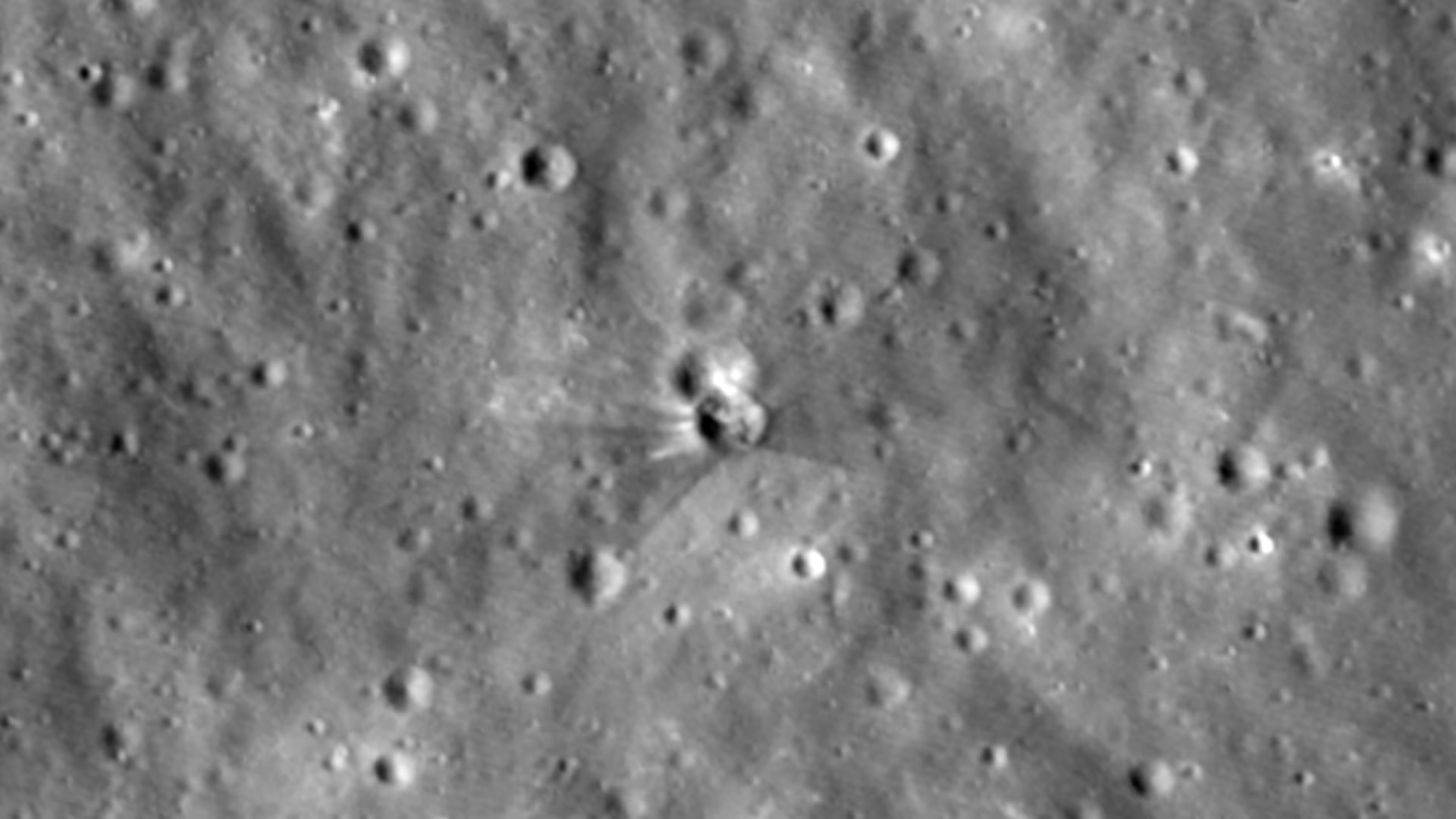
Un étage de fusée SpaceX s’écrase sur la Lune : la NASA photographie le cratère
Le 5 août 2026, un étage supérieur de Falcon 9 a percuté la Lune à 8 690 km/h. La sonde LRO de la NASA a photographié le cratère de 18,3 mètres créé lors de l’impact.
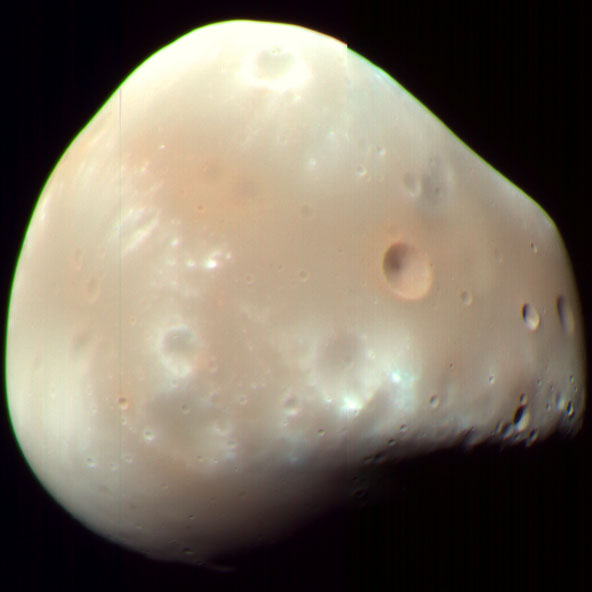
Un impact d’astéroïde unique pourrait expliquer l’apparence de Deimos
Un astéroïde de 320 mètres a frappé Deimos à 45 degrés, créant sa surface lisse et son bassin polaire sud, révèle une étude parue dans Nature Astronomy le 18 août 2026.