
The engine of a quasar is based on a supermassive black hole. When a large amount of gas falls toward it, the matter compresses and heats up to millions of degrees. This process, called accretion, releases colossal power—far greater than that of a normal star.
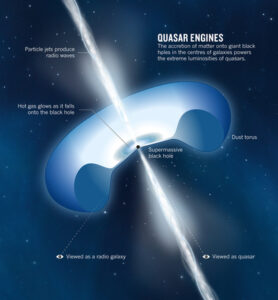
The accretion disk then transforms into a gigantic furnace. It emits X-rays, ultraviolet rays, and even radio waves, producing a luminosity so intense that it can exceed that of an entire galaxy. It is this extreme light that makes it possible to detect quasars, even when they are tens of billions of light-years away.
Surprisingly, the power of a quasar depends directly on the rate at which matter falls into the disk. The faster the matter falls toward the black hole, the brighter the object becomes. Some quasars fluctuate like cosmic lighthouses, changing in intensity over months or years.
Sometimes, part of the gas spirals so violently that the magnetic field lines coil up and form relativistic jets. These jets of energy, launched at nearly the speed of light, extend far beyond the parent galaxy and even sculpt intergalactic space. They are among the most impressive phenomena ever observed.
Quasars come in several forms, depending on the orientation of their jets, their activity, or their energy. Some emit large amounts of radio waves: these are called radio-luminous quasars. Their power generally comes from relativistic jets capable of crossing their entire host galaxy.
Other quasars are much more discreet in this range. These are radio-quiet quasars. Despite their name, they remain just as bright in visible and ultraviolet light. They even represent the majority of known quasars.
Finally, one category stands out for its extreme violence: blazars. Their jets are almost aligned with the direction of Earth. This orientation acts as a natural amplifier, making their light more intense and highly variable. Some fluctuations appear in just a few hours, offering a direct glimpse of phenomena close to the central black hole.
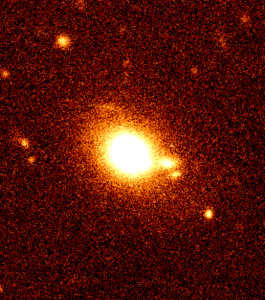
ULAS J1342+0928 is one of the most distant quasars ever observed. Its light traveled more than 13.1 billion years before reaching Earth. This means that it has been shining since a time when the universe was only 690 million years old, in the midst of its cosmic infancy.
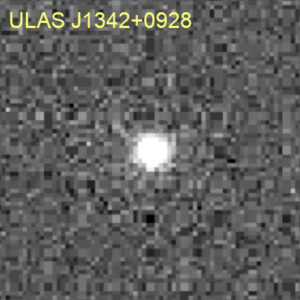
Its supermassive black hole has a staggering mass of about 800 million Suns. Such growth, in such a short time after the Big Bang, still defies current models. Researchers are trying to explain how a monster of this magnitude could have emerged so early in cosmic history.
ULAS J1342+0928 also plays a crucial role in the study of reionization, a period when light from the first stars and galaxies cleared the fog of neutral hydrogen that filled the universe. Observing this quasar is like probing directly into the cosmic dawn, a time when the very first structures in space were forming .
Le télescope spatial Roman de la NASA s’envole vers les étoiles
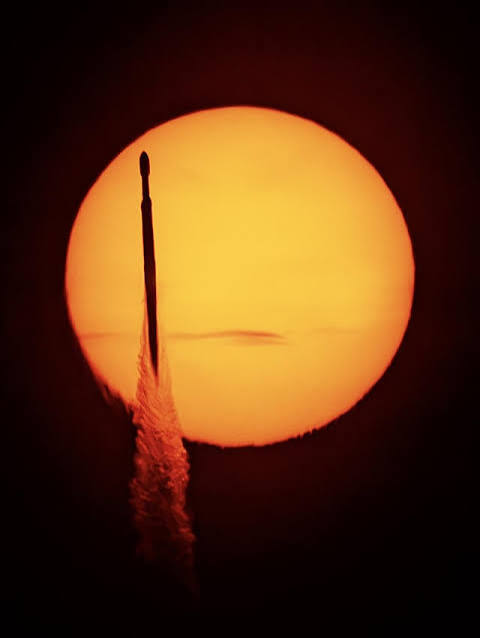
Le télescope spatial Nancy Grace Roman a décollé avec succès le 30 août 2026 à bord d’une Falcon Heavy de SpaceX depuis Cap Canaveral. Avec un champ de vision 100 fois supérieur à Hubble, il va cartographier l’énergie noire, les exoplanètes et des milliards de galaxies.
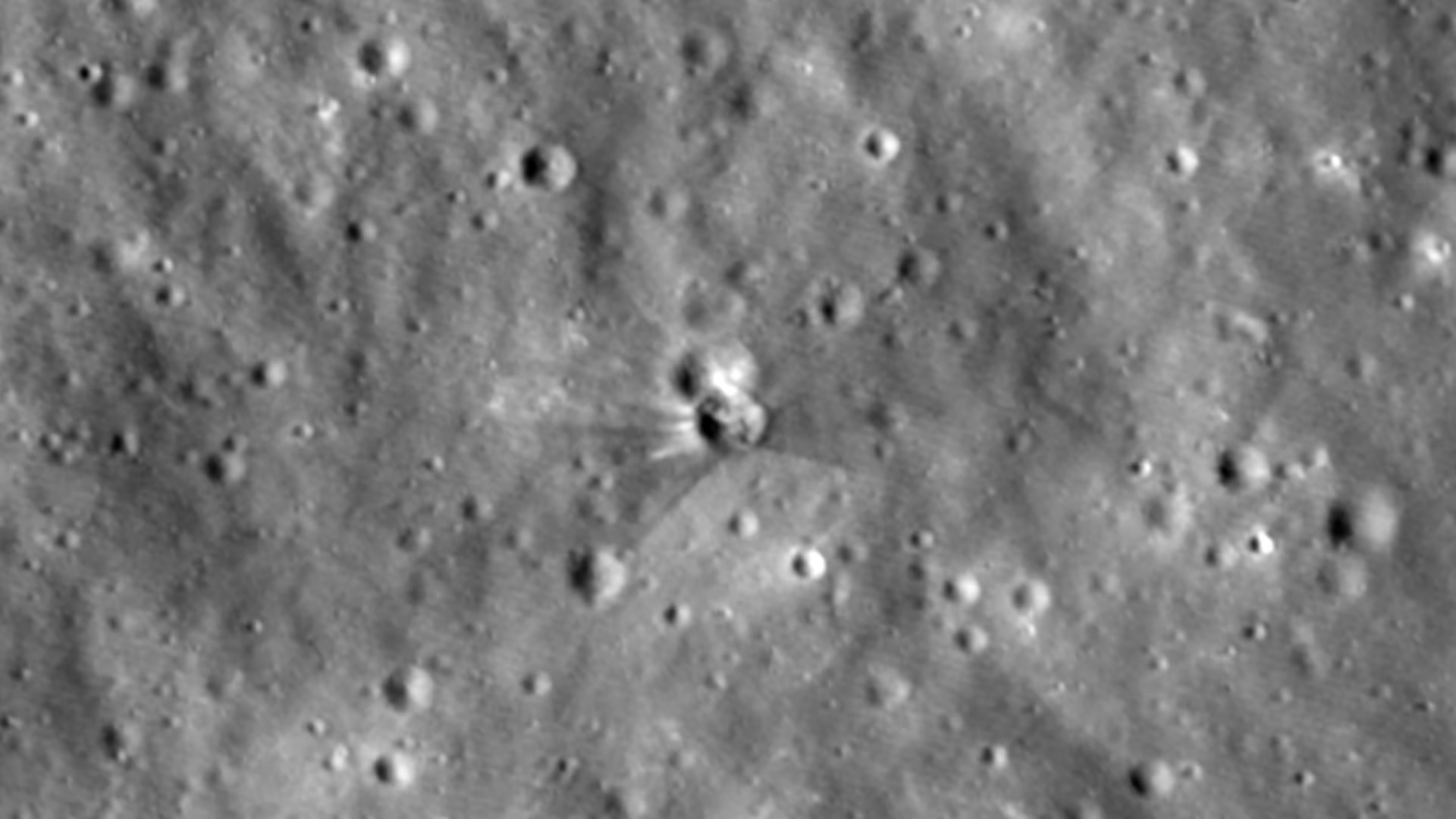
Un étage de fusée SpaceX s’écrase sur la Lune : la NASA photographie le cratère
Le 5 août 2026, un étage supérieur de Falcon 9 a percuté la Lune à 8 690 km/h. La sonde LRO de la NASA a photographié le cratère de 18,3 mètres créé lors de l’impact.
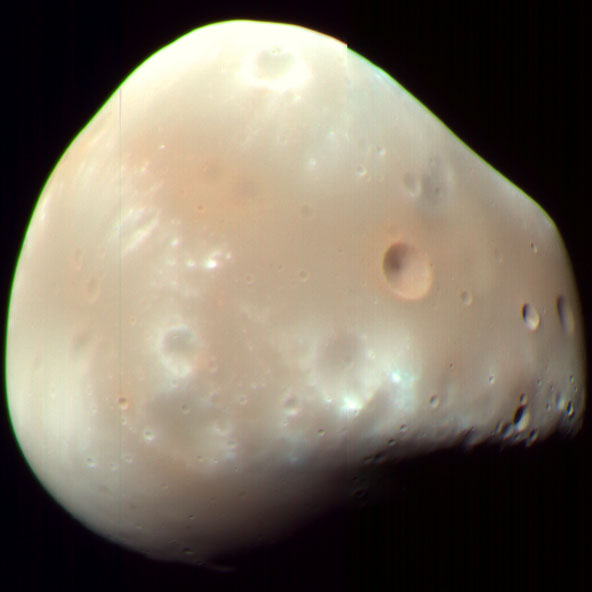
Un impact d’astéroïde unique pourrait expliquer l’apparence de Deimos
Un astéroïde de 320 mètres a frappé Deimos à 45 degrés, créant sa surface lisse et son bassin polaire sud, révèle une étude parue dans Nature Astronomy le 18 août 2026.