
The Sun: Living Heart of the Solar System
Our Star in Action
A natural nuclear reactor for 4.6 billion years
The Sun is not just a bright disk in the sky. It is a giant star, a natural nuclear reactor that shapes everything we know. Without it, Earth would be a sphere of ice plunged into eternal silence. Thanks to its energy, the oceans move, plants grow, and life exists. In short, it is the beating heart of all living things.
Approximately 4.6 billion years old, our star was born from a huge cloud of gas and dust called the solar nebula. Under the effect of gravity, this cloud collapsed in on itself to form a burning ball of plasma: the Sun. Around it, the remaining debris gathered to give birth to the planets, moons, and asteroids.
The Nuclear Reactor at the Heart of the Sun
At the center of the Sun, the temperature exceeds 15 million degrees. This is where nuclear fusion occurs: hydrogen nuclei combine to form helium, releasing colossal energy in the form of light and heat.
Every second, approximately 600 million tons of hydrogen disappear in this process. It is this constant reaction that has fueled its brilliance for billions of years.
This balance is fragile. On one side, gravity tends to compress it; on the other, the pressure from fusion pushes outward. As long as these forces remain balanced, the Sun remains stable.

Nuclear fusion: the energy of the stars
Nuclear fusion transforms four hydrogen nuclei into one helium nucleus. The difference in mass is converted into energy according to Einstein's famous equation: E=mc². This energy takes about 100,000 years to travel from the core to the surface, bouncing endlessly between particles. Once at the surface, it escapes into space in the form of light—the light that illuminates us today.
The Layered Structure of the Sun
The Sun is not a homogeneous ball. It is organized into several distinct layers, each playing an essential role in the functioning of our star.
This is the core of the reactor, where temperatures reach 15 million degrees. Nuclear fusion converts 600 million tons of hydrogen into helium every second. It accounts for about 25% of the sun's radius.
In this region (25% to 70% of the radius), energy progresses slowly by radiation. Photons take tens of thousands of years to cross it, bouncing endlessly between particles in an infinite dance.
Closer to the surface (70% to 100% of the radius), hot plasma rises and cold plasma sinks, creating huge convection cells. This constant movement transports energy from the core to the surface in just a few weeks.
This is the "surface" we see, with a temperature of around 5,500°C. Only 400 km thick, it is dotted with sunspots — darker areas created by intense magnetic fields.
Beyond the photosphere lie the chromosphere (the red atmosphere visible during eclipses) and the corona —a mysterious region reaching several million degrees, hotter than the surface itself! It is from here that the solar wind escapes, a constant stream of charged particles that traverses the entire Solar System.
A Star in Constant Motion
Under its unchanging light, the Sun is nevertheless in constant turmoil. Its surface, called the photosphere, is a sea of boiling plasma. Huge convection cells rise and fall relentlessly, much like boiling water.
Approximately every 11 years, the Sun goes through a cycle of activity. During this period, dark spots appear: these are areas where the magnetic field is particularly intense. These fields can twist and break, sometimes causing solar flares or coronal mass ejections.
The aurora borealis: a solar spectacle on Earth
When coronal mass ejections reach Earth, they can disrupt our electrical grids and satellites. However, they also offer a spectacular show: the polar auroras, those green, red, and purple veils that light up the poles. Thus, even at a distance of 150 million kilometers, the Sun continues to interact with our planet in spectacular ways.
The Destiny of a Star
Like all stars, the Sun will not last forever. In about 5 billion years, it will have exhausted its hydrogen supply. Its core will contract, the heat will increase, and it will swell to become a red giant.
The future evolution of the Sun
Indeed, the atoms created in its core—carbon, oxygen, iron— will one day be used to form new stars, new planets, and perhaps... new life. The Sun will never truly die: its legacy will live on in the galaxy.
Did you know?
- The Sun accounts for 99.86% of the total mass of the Solar System.
- Its surface reaches approximately 5,500°C, while its core exceeds 15 million degrees.
- It rotates once every 27 days at the equator, but more slowly at the poles (35 days).
- It loses about 4 million tons of material every second, converted into energy.
- Its light contains all the colors of the visible spectrum, which explains why daylight appears white.
- The particles it emits, called solar wind, form a giant bubble around the solar system: the heliosphere.
- The light you see left the Sun more than 8 minutes ago —we still see it in the past.
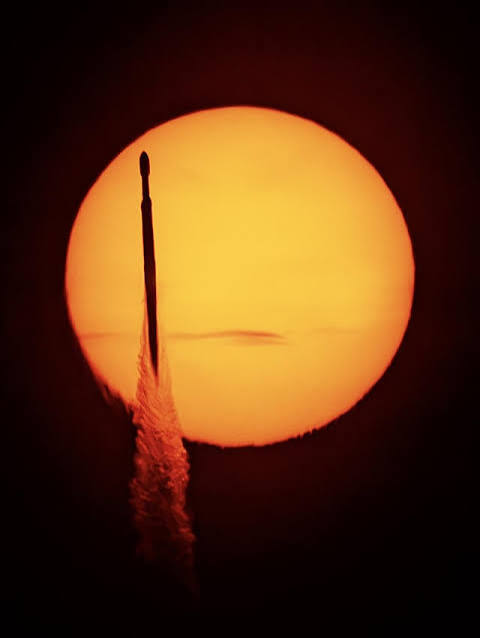
Le télescope spatial Roman de la NASA s’envole vers les étoiles
Le télescope spatial Nancy Grace Roman a décollé avec succès le 30 août 2026 à bord d’une Falcon Heavy de SpaceX depuis Cap Canaveral. Avec un champ de vision 100 fois supérieur à Hubble, il va cartographier l’énergie noire, les exoplanètes et des milliards de galaxies.
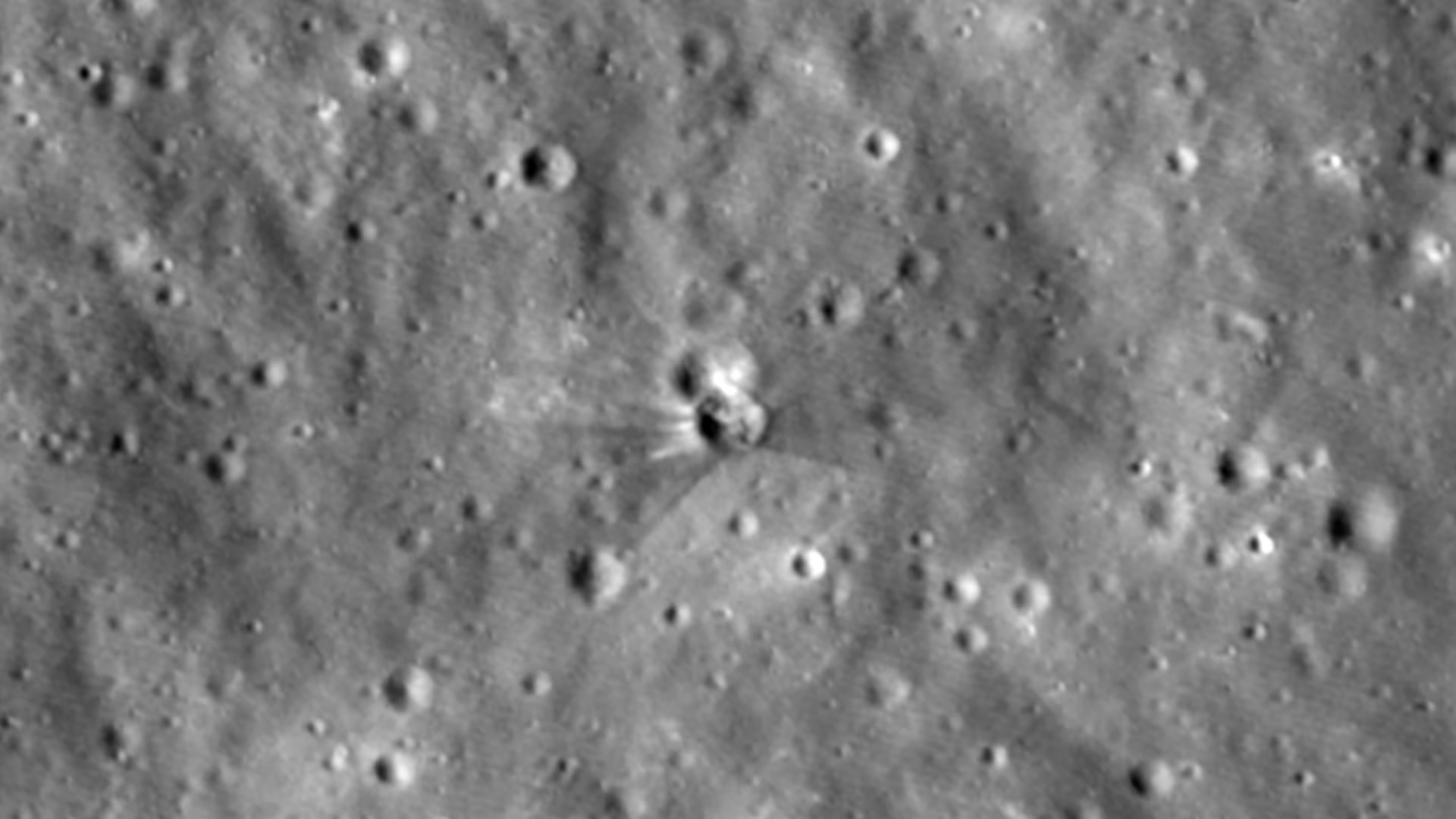
Un étage de fusée SpaceX s’écrase sur la Lune : la NASA photographie le cratère
Le 5 août 2026, un étage supérieur de Falcon 9 a percuté la Lune à 8 690 km/h. La sonde LRO de la NASA a photographié le cratère de 18,3 mètres créé lors de l’impact.
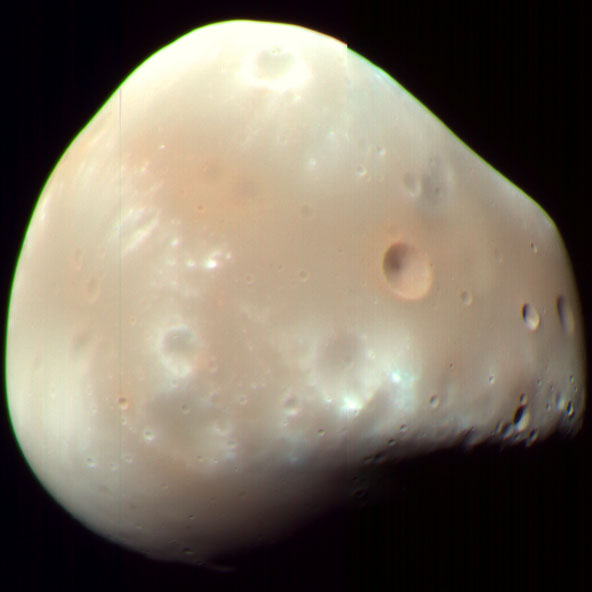
Un impact d’astéroïde unique pourrait expliquer l’apparence de Deimos
Un astéroïde de 320 mètres a frappé Deimos à 45 degrés, créant sa surface lisse et son bassin polaire sud, révèle une étude parue dans Nature Astronomy le 18 août 2026.